


.png)
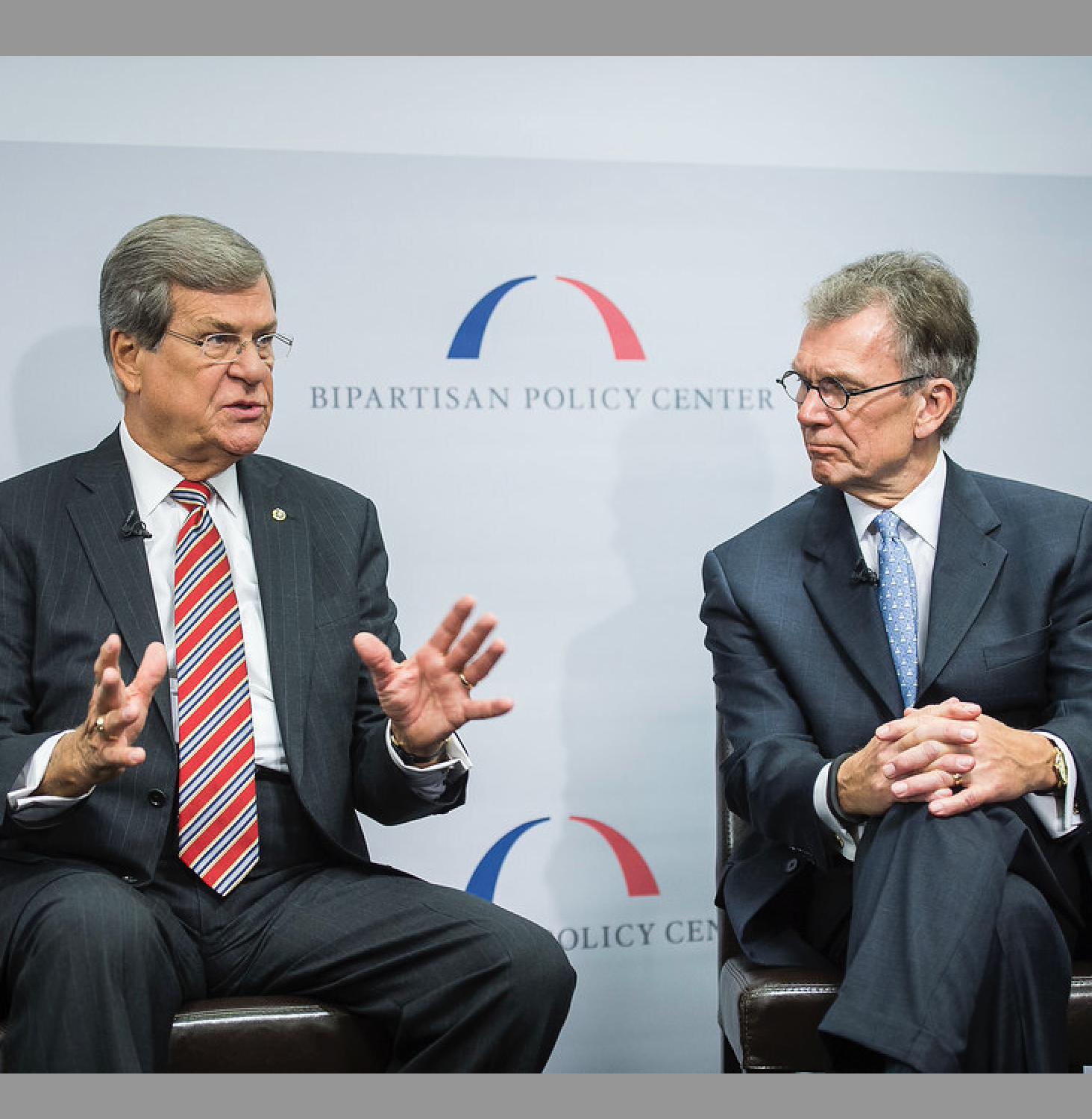
The two of us served in Congress for a total of fifty-nine years, sixteen of them as Senate majority or minority leaders. When we came to Congress in the 1970s, Congress was far less polarized than it is today. By the mid-1990s, when we became the leaders of our respective parties in the closely divided Senate, the rise in partisan rancor was already on full display, including during the fraught impeachment proceedings of President Clinton.
Nonetheless, we count our time as Senate leaders as one where the two parties could seek common ground. We take pride that we were able to come together on many important pieces of legislation during the Clinton and Bush presidencies. Even when we disagreed, we kept lines of communication open.
The growing polarization since we left Congress led us to come together to warn the nation of its perils in 2016 (Crisis Point). In the book, we note that the center can no longer hold under such mindless and unprecedented partisanship – and it is no exaggeration to say that the state of our democracy is as bad as we’ve ever seen it. In noting that Congress is being reshaped in sharper, more discrete divisions, we observed that primaries only encourage this. These critical elections, by which candidates make it to the general election ballot, give an advantage to the extremes over moderates and alienate voters with their negativity.
As alarmed as we were when we published Crisis Point, the dysfunction of extreme partisanship has grown substantially in the decade since. In this climate, primaries play even more important and troubling roles. Fearing they will be “primaried,” members of Congress believe even more strongly now that they have more to gain from standing their ground and blocking reasonable legislation entirely than making the necessary compromises to enact solutions that serve their constituents’ interests. Today, it is almost unheard of for a Democrat to win elections in our home states of Mississippi or South Dakota, just as it is rare for Republicans to win elections in New England or in America’s larger cities, making primary elections more important for members of Congress. Many lawmakers clearly believe that primary election outcomes are not driven by what one can do for their district, but by how successfully they demonize the opposing party. Even saying a kind word or appearing in public with members of the opposing party can cause trouble in a primary campaign.
In this climate of playing to the base of one’s party, the voters who dominate in primary elections, too many Americans are shut out of the process of choosing their elected leaders. When primary turnout hovers below twenty percent of the electorate, and when the primary is, in many parts of the country, the only election that matters, it is no wonder that politicians stop listening to the full range of citizens they are elected to represent and that their constituents, in turn, feel disenfranchised.
Something needs to be done. That is why we wrote our 2016 book and were proud to lead a Bipartisan Policy Center Taskforce in 2014 to consider ways of governing in our polarized era. For example, our report urged states to adopt open or semi-open primaries to encourage candidates to reach out to voters who are not reflexive partisans. We also suggested the establishment of a single-day national primary.
The magnitude of the problem is such that we cannot stop at primary reforms. We believe they must be undertaken along with changes to the way we draw congressional districts, to our campaign finance laws, and to how Congress operates. Distressing as the current state of our politics is, we take genuine encouragement from states experimenting with reforms designed to increase the participation and representativeness of primary elections. We are also impressed by the growing sophistication of research investigating these reforms. The chapters in Reforming Primary Elections (2026), for example, document how primary elections have changed over the past decade, examine the impacts of reforms already implemented, and consider promising but as-yet-untested ideas.
Our experience working together demonstrates that election reform need not be a partisan issue. It is in the interest of all Americans to ensure that our politicians represent us. Substantial, bipartisan majorities of Americans agree that our government has lost their trust and that political compromise is important. When partisan cues are not present, Americans of both parties agree on many political reforms. The imperative to reform our elections is more important than ever. The task before us is to understand what is wrong, what might work, and how to get there.
Our democracy is worth fighting for, and the power to fortify it is in our hands.
—-
This is the abridged preface from Reforming Primary Elections Voters, Campaigns, and the Future of Congressional Politics (2026, De Gruyter Brill), which is free to download.

Stay up-to-date on the latest news and resources from Unite America.


.png)
%20(1).png)
.png)